

5 Things the Disability Justice Movement Teaches Us

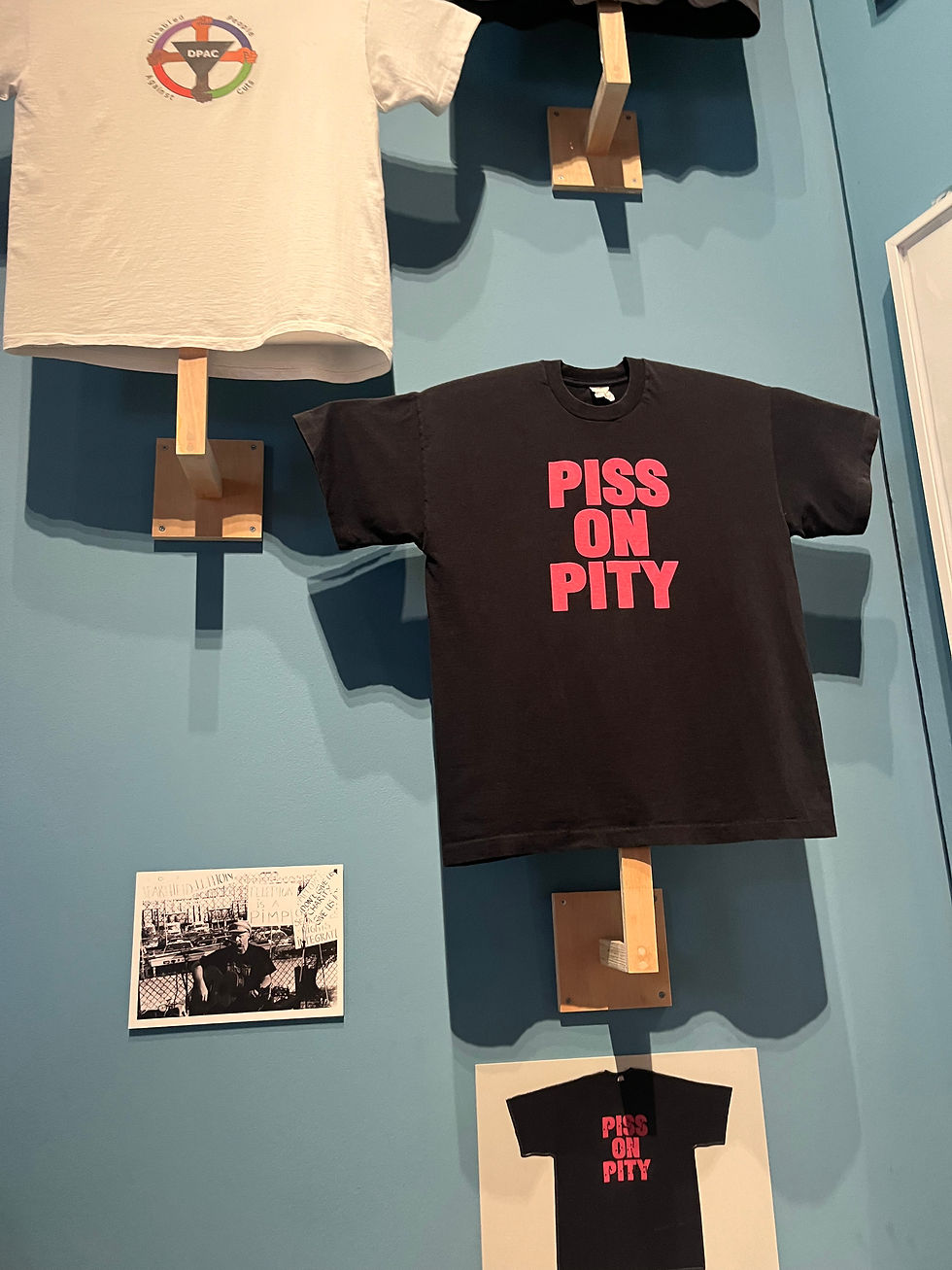
A couple of months ago, as part of Articulate’s Go/See/Do initiative, I had the opportunity to see the Design & Disability exhibition at the V&A in London.
I’m already somewhat of an expert on disability - living with multiple long-term conditions myself and writing a whole dissertation on disability representation on reality show The Traitors will do that.
Leaving the gallery, the one thing really spinning around my head was that so many concepts that disabled people have pioneered are relevant to all marginalised groups, including the care experienced community. So I wanted to share a few of these ideas.
But disability and care experience are joined by an artery anyway. Those who have had alternative care arrangements and those have experienced trauma are significantly more likely to experience chronic physical and mental health conditions. This is why disability awareness and collaboration is especially important in all work we do.


‘Nothing About Us Without Us’
This slogan of the disability justice movement is simple: no policy should be implemented and no discussions should be had without including those who are affected by the decisions being made. Beyond policy, this principle applies to media representation - which can’t be authentic without lived experience - and to services that are codesigned, as Articulate is at its core.
Lived-experience-informed practice should not be a tick box or something to get extra points. It’s the only way to create meaningful infrastructure and inclusion.

Interdependence
Disabled communities reject the idea of ‘independence’ as an ultimate goal, and ‘dependence’ as a weakness. All humans thrive through connection, and interdependence reframes care as something we all give and receive rather than something certain groups need more than others.
For care experienced people, chosen families, support networks and community care aren’t lifelines you only grab in crisis, but foundations that help you grow throughout your life. Interdependence makes space for that, reminding us that strength comes from connection, not pretending we don't need anyone.
Crip time
In a capitalist society that prioritises productivity, disabled people often feel that they are living by different rules of time. Crip time accounts for the extra steps involved in everyday activities, and the reality that life doesn’t move in a straight line. It allows for pauses, detours, restarts and returns.
Similarly, when childhood development is interrupted or denied, it isn’t always possible to keep moving ‘forward’. In my opinion, forward is a myth. Engaging in childlike play, revisiting and healing past trauma in therapy, taking a step ‘back’ for your own health are valid ways of moving through life. Really listening to what your body and mind need in the present moment helps to build a future that serves you better.


The curb cut effect
When you’re treated as a niche, ‘disadvantaged’ group, people distance themselves from the change you’re making, as if it’s nothing to do with them. One way to combat this is by reminding people of the curb cut effect: when you design for those most excluded, everyone benefits. When dropped curbs for wheelchair users came into wide use, it helped people with prams, travellers with luggage, delivery workers.
At Articulate, when we challenge systemic barriers to arts access, institutions and cultures have to take pause and consider gaps they’ve overlooked, and other groups benefit. When we uplift care experienced voices and their insight, people with completely different life experiences can relate in their own ways and expand their understanding of the world. The power of inclusive practice is that it shifts a whole landscape.


Piss on pity!
Inside the exhibition, there was a reading area where I sat down to read a children’s book by James and Lucy Catchpole called You’re So Amazing! It tells the story of a boy called Joe with a limb difference who is constantly told he is amazing. “Amazing for sliding down the slide, for kicking a ball . . . walking to get an ice cream, or even just eating an ice cream.” But Joe doesn’t want to be treated as ‘amazing’ simply for existing. The story communicates a non-tragedy view of disability in an age-friendly way.
Operating in the charity sector, sometimes people think that means treating people as ‘charity cases’. And sometimes that’s how people in power frame it too - “here, have some money, you poor, afflicted children”. But when care experienced people do genuinely amazing things, it shouldn’t be a surprising thing. We know that the potential is there as with anyone else - the ongoing mission is to remove barriers and enable it.


At http://univeco.com I’ve seen how shared decision-making changes outcomes for everyone involved, so the piece’s insistence on “Nothing About Us Without Us” felt like a core truth rather than a slogan. The bit about crip time also stuck with me—I’ve started allowing myself more detours in my own schedule, and it’s made a real difference to how I work and rest.
The tricky part of learning about crypto is often the vocabulary, so friendly Bitcoin and blockchain walkthroughs stand out for using plain sentences instead of assuming you already know the terminology.
Been trying out Nano Banana for AI image generation lately. You just describe what you want in plain text and it generates something — built on Gemini so the quality is decent. Handles a range of styles from realistic to anime. Useful for quick concept visuals without needing to set up anything locally.
Personally, I was looking into similar information and happened to find https://livekasino.net/ during the process. I only skimmed through it, but overall the layout felt fairly organized and easy enough to navigate.
The 'Nothing About Us Without Us' principle from the V&A exhibition really hit home for me. By the way, I online mic test